
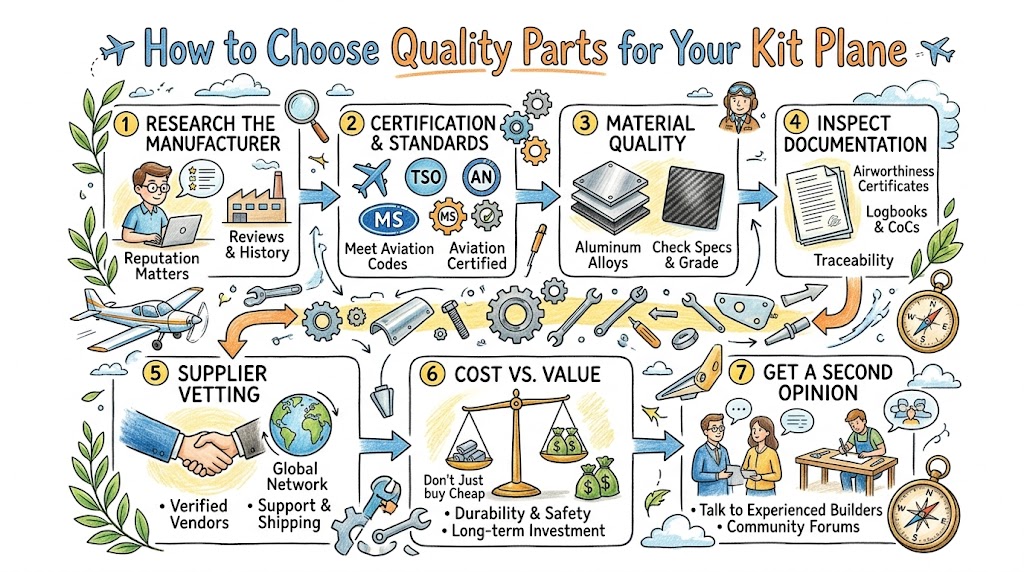
Introduction
Building or maintaining a kit plane is one of the most rewarding experiences in aviation. It gives aircraft enthusiasts, private pilots, and experimental aircraft builders the opportunity to understand every part of their aircraft from the inside out. However, with that freedom comes a serious responsibility: choosing the right parts. Every bracket, bolt, wire, fuel line, control cable, and structural component plays a role in safety, performance, reliability, and long-term aircraft value.
Choosing quality parts for your kit plane is not only about finding components that fit. It is about selecting parts that are safe, compatible, well-documented, durable, and suitable for aviation use. Poor-quality or incompatible parts can create installation problems, increase maintenance risk, affect performance, and compromise flight safety. On the other hand, carefully selected parts help builders complete projects with confidence, reduce delays, and create aircraft that are more reliable and easier to maintain.
This guide explains how kit plane builders and experimental aircraft owners can choose quality parts, evaluate suppliers, compare new and used components, avoid common buying mistakes, and build a safer, better-documented aircraft.
Real-World Use Cases
Quality parts matter in every stage of kit plane ownership, from the first build phase to long-term maintenance and resale preparation.
- First-time kit plane builders: Quality parts help new builders avoid costly mistakes, incorrect fittings, and repeated rework during assembly.
- Experimental aircraft owners: Reliable parts improve operational confidence and reduce unexpected maintenance problems.
- Private pilots: Good components support safer flight operations and reduce the risk of preventable system issues.
- Project builders: Properly sourced parts reduce delays caused by poor fit, missing documentation, or supplier problems.
- Long-term aircraft owners: Durable, compatible parts help control maintenance costs and preserve aircraft performance.
- Aircraft sellers: A well-built aircraft with documented parts can improve buyer confidence and resale readiness.
Evaluation Criteria for Buyers
Before buying any kit plane part, builders should evaluate the component from a safety, compatibility, documentation, and supplier reliability perspective. A part that looks acceptable may still be unsuitable if it lacks proper information, does not match the aircraft design, or comes from an unreliable source.
Important evaluation criteria include:
- Material quality: Check whether the material is suitable for aviation use and appropriate for the specific application.
- Part compatibility: Confirm the part fits your aircraft model, kit version, system layout, and installation requirements.
- Manufacturer reputation: Buy from suppliers or manufacturers known for aircraft-grade components and reliable support.
- Documentation and traceability: Look for part numbers, specifications, invoices, manuals, or installation guidance.
- Fit and finish: Inspect machining quality, surface finish, hole alignment, edges, welds, and overall workmanship.
- Weight and performance impact: Avoid parts that add unnecessary weight or affect balance, efficiency, or handling.
- Safety record: Consider whether the part type or supplier has known reliability concerns.
- Warranty or return support: Choose suppliers with clear return, exchange, or support policies.
- Supplier reliability: Evaluate lead times, communication, stock availability, and transparency.
- Replacement availability: Prefer parts that can be replaced or serviced easily in the future.
Best for
This guide is best for kit plane builders, experimental aircraft owners, aviation DIY enthusiasts, and private pilots who want safer and more reliable aircraft parts. It is especially useful for builders who want to avoid poor buying decisions, project delays, and undocumented components. It also helps owners think more clearly about compatibility, supplier quality, and long-term maintenance.
Not Ideal for
This guide is not a replacement for official aircraft manuals, engineering advice, professional inspections, or aviation authority requirements. Builders should always follow the kit manufacturer’s instructions and consult qualified aviation professionals when needed. Any safety-critical uncertainty should be resolved before installation or flight.
Why Quality Kit Plane Parts Matter
Choosing quality kit plane parts is one of the most important decisions a builder can make. The aircraft may be experimental, but the risks of poor-quality components are very real.
Flight Safety
Every aircraft part contributes to safe operation. Structural hardware, control system parts, engine components, electrical connections, and fuel system fittings must perform correctly under vibration, temperature changes, load, and flight conditions. A weak or incompatible part can create serious safety concerns.
Structural Reliability
Kit planes depend on proper alignment, correct fasteners, strong materials, and secure assembly. High-quality structural parts help maintain aircraft strength and reduce the risk of fatigue, cracking, or premature wear.
Better Aircraft Performance
Weight, fit, airflow, engine efficiency, and control response can all be affected by parts selection. Choosing the right components helps preserve the aircraft’s intended performance.
Reduced Maintenance Issues
Poor-quality parts often create repeated maintenance problems. A cheap fitting, weak connector, or poorly machined bracket may require replacement sooner than expected. Quality parts reduce recurring issues.
Easier Installation
Parts with proper dimensions, clean finish, and clear documentation are easier to install. This saves time and reduces frustration during the build process.
Improved Resale Value
Buyers often look closely at build quality, maintenance records, part documentation, and overall workmanship. A kit plane built with well-documented quality parts can create stronger buyer confidence.
Long-Term Cost Control
Low-cost parts may become expensive if they fail early, cause damage, or require rework. Quality parts may cost more upfront but often provide better long-term value.
Builder Confidence
Building an aircraft requires trust in every component. When parts are properly selected, documented, and installed, builders can move forward with greater confidence.
Types of Kit Plane Parts Buyers Should Evaluate
Kit planes include many different systems and component categories. Each category has its own quality considerations, risks, and buying priorities.
1- Structural Parts
Structural parts form the foundation of the aircraft. These components must be strong, properly manufactured, and compatible with the aircraft design.
What Structural Parts Include
- Spars
- Ribs
- Brackets
- Panels
- Bulkheads
- Frames
- Composite materials
- Aluminum components
- Load-bearing fittings
- Aviation-grade fasteners
What to Check
When evaluating structural parts, check for correct dimensions, material grade, corrosion protection, proper drilling, clean edges, and visible defects. For composite parts, inspect for delamination, cracks, voids, and poor bonding. For metal parts, inspect for scratches, dents, corrosion, bending, and poor machining.
Why It Matters
Structural parts carry loads during flight, landing, and ground handling. Poor-quality structural components can affect aircraft strength, alignment, and long-term durability.
2- Engine and Propulsion Components
Engine and propulsion parts directly affect aircraft reliability and performance. These parts should be selected carefully because engine-related failures can create serious flight risks.
What Engine and Propulsion Parts Include
- Engine mounts
- Fuel system parts
- Exhaust components
- Ignition parts
- Cooling parts
- Propeller-related components
- Carburetor or fuel injection parts
- Oil system parts
- Vibration isolation components
What to Check
Check compatibility with your engine model, installation layout, cooling requirements, vibration limits, and aircraft performance goals. Inspect welds, fittings, hoses, clamps, seals, and mounting points. For propeller-related parts, confirm correct specifications, balance requirements, and manufacturer guidance.
Why It Matters
Engine and propulsion parts operate under heat, vibration, pressure, and load. High-quality components reduce the risk of leaks, overheating, vibration damage, and performance problems.
3- Avionics and Electrical Parts
Modern kit planes often include advanced avionics and electrical systems. Even simple aircraft need reliable wiring, switches, breakers, connectors, and battery systems.
What Avionics and Electrical Parts Include
- Wiring
- Switches
- Circuit breakers
- Batteries
- Radios
- Navigation systems
- Cockpit displays
- Sensors
- Antennas
- Connectors
- Lighting systems
What to Check
Check voltage compatibility, current ratings, wire quality, connector type, circuit protection, installation space, and system integration. Avionics should be compatible with your panel layout, power supply, antenna setup, and intended flight operations.
Why It Matters
Electrical issues can cause communication failures, instrument problems, lighting issues, and unreliable system behavior. Good wiring and avionics parts improve safety, reliability, and cockpit confidence.
4- Landing Gear and Brake Parts
Landing gear and brakes experience repeated stress during taxi, takeoff, landing, and ground handling. These parts must be strong, properly fitted, and maintained.
What Landing Gear and Brake Parts Include
- Wheels
- Tires
- Brake assemblies
- Hydraulic parts
- Struts
- Axles
- Steering components
- Brake lines
- Calipers
- Bearings
What to Check
Inspect tire quality, wheel condition, brake pad compatibility, axle fit, hydraulic fittings, and steering hardware. Used landing gear parts should be inspected carefully for cracks, bending, corrosion, and impact damage.
Why It Matters
Landing gear and brakes are critical during landing and ground operation. Poor-quality parts can affect stopping distance, directional control, and aircraft handling.
5- Control System Parts
Control system parts connect pilot input to aircraft movement. These parts must be precise, smooth, secure, and free of excessive wear.
What Control System Parts Include
- Cables
- Pulleys
- Rods
- Hinges
- Bearings
- Linkages
- Bellcranks
- Control surface hardware
- Bushings
- Turnbuckles
What to Check
Check for proper fit, smooth movement, correct length, secure attachment, and material quality. Inspect cables for fraying, pulleys for wear, bearings for smoothness, and linkages for looseness.
Why It Matters
Control systems must operate smoothly and reliably. Any binding, looseness, poor alignment, or weak hardware can affect aircraft handling and safety.
6- Interior and Cabin Parts
Interior parts improve comfort, usability, and safety. While they may not always seem as critical as structural or engine components, they still require careful selection.
What Interior and Cabin Parts Include
- Seats
- Harnesses
- Panels
- Flooring
- Insulation
- Cabin lighting
- Ventilation parts
- Safety equipment
- Interior trim
- Storage components
What to Check
Check weight, flame resistance where applicable, durability, fit, comfort, and secure installation. Seat belts and harnesses should be selected with special care because they are safety-critical components.
Why It Matters
Interior choices affect weight, comfort, cockpit usability, and emergency safety. Poorly installed interior parts may interfere with controls or create loose objects in flight.
7- Hardware and Fasteners
Hardware and fasteners may be small, but they are among the most important parts in a kit plane. Using incorrect or low-quality hardware can create serious risks.
What Hardware and Fasteners Include
- Bolts
- Nuts
- Washers
- Rivets
- Screws
- Clamps
- Safety wire
- Cotter pins
- Hinges
- Aviation-grade hardware
What to Check
Confirm size, grade, material, thread type, corrosion protection, and intended application. Avoid hardware with unclear origin, poor finish, damaged threads, or missing specifications.
Why It Matters
Fasteners hold the aircraft together. Non-aviation-grade hardware may not meet strength, vibration, or corrosion requirements for aircraft use.
8- Fuel and Fluid System Parts
Fuel and fluid systems must be leak-free, compatible with the fluids used, and properly installed. Poor-quality parts in these systems can create safety and reliability problems.
What Fuel and Fluid System Parts Include
- Fuel tanks
- Fuel pumps
- Fuel filters
- Fuel lines
- Fittings
- Valves
- Vents
- Seals
- Clamps
- Fluid-compatible hoses
What to Check
Check fuel compatibility, pressure rating, temperature rating, hose condition, fitting quality, and installation requirements. Make sure lines and fittings are suitable for aviation use and the specific fuel type.
Why It Matters
Fuel leaks, blocked filters, poor venting, or incompatible hoses can affect engine performance and create safety risks. Fluid system parts should never be chosen casually.
How to Identify High-Quality Kit Plane Parts
A quality part is more than a part that looks clean or new. Builders should use a structured evaluation process before buying and installing any component.
Verify Part Specifications
Check dimensions, part number, material, rating, and intended application. Make sure the component matches the aircraft kit requirements.
Check Material Grade
Material grade matters for strength, weight, corrosion resistance, and durability. Do not assume that similar-looking parts are equal.
Review Supplier Background
Choose suppliers with aviation experience, clear product information, and responsive support. A supplier that cannot answer basic questions may not be the right source for safety-critical parts.
Inspect Machining or Finish Quality
Look for clean edges, accurate holes, smooth surfaces, correct bends, and consistent finish. Poor workmanship can indicate poor manufacturing control.
Confirm Compatibility With the Aircraft Kit
A part may be high-quality but still wrong for your aircraft. Always confirm model compatibility, kit version, and installation requirements.
Check Documentation and Part Numbers
Good parts should have clear identification. Keep invoices, part labels, installation instructions, and any available specifications.
Avoid Unknown or Unverified Parts
Avoid parts with unclear origin, missing specifications, or no supplier support. Unknown parts can create risk and future maintenance confusion.
Compare Weight and Performance Impact
Extra weight can affect useful load, balance, climb performance, and fuel efficiency. Lightweight parts should still meet safety and durability requirements.
Ask Experienced Builders or Mechanics
Experienced builders, mechanics, and aircraft communities can help identify practical issues that may not be obvious during purchase.
Review Return and Support Policies
A clear return policy protects you if the part does not fit, arrives damaged, or does not match the advertised specifications.
New vs Used Kit Plane Parts
Both new and used parts can have a place in a kit plane project, but they require different levels of caution. New parts usually provide better documentation and confidence, while used parts may offer cost savings if inspected carefully.
| Factor | New Parts | Used Parts | Buyer Recommendation |
|---|---|---|---|
| Safety | Generally more predictable when sourced properly | Depends heavily on condition and history | Use new parts for safety-critical systems when possible |
| Cost | Usually higher upfront | Often lower upfront | Balance savings against inspection risk |
| Documentation | Usually better documentation and purchase records | May have limited or missing records | Avoid undocumented critical parts |
| Condition | Unused and typically easier to inspect | May have wear, corrosion, or hidden damage | Inspect used parts carefully before installation |
| Warranty | Often includes supplier support or return options | Usually limited or unavailable | Prefer warranty-backed parts for expensive components |
| Availability | May require lead time | May be available immediately | Confirm fit before buying either option |
| Inspection Needs | Still requires verification before use | Requires detailed inspection | Have used critical parts reviewed by qualified professionals |
| Best Use | Critical systems, structural components, avionics, fuel systems | Non-critical or easily inspected components | Choose based on risk level and documentation |
Common Mistakes Kit Plane Builders Should Avoid
Kit plane builders can save time, money, and stress by avoiding common buying mistakes. Many issues happen because a part was selected too quickly or because the buyer focused only on price.
Buying Parts Only Based on Lowest Price
The cheapest part is not always the best value. A low-cost part that fails early, does not fit, or lacks documentation can become expensive quickly.
Ignoring Compatibility
Always confirm that the part matches your aircraft model, kit version, and installation requirements. Similar-looking parts may not be interchangeable.
Using Non-Aviation-Grade Hardware
Automotive or general-purpose hardware may not be suitable for aircraft loads, vibration, temperature, or corrosion exposure.
Skipping Documentation Checks
Missing documentation can create confusion during inspections, maintenance, resale, and troubleshooting.
Not Inspecting Used Parts Properly
Used parts may have hidden wear, corrosion, cracks, or previous damage. Inspect thoroughly before installation.
Mixing Incompatible Materials
Some materials can react with each other or create corrosion issues. Material compatibility is especially important in structural and fluid system areas.
Ignoring Weight Impact
Every part contributes to total aircraft weight. Excessive weight can affect balance, useful load, and performance.
Buying From Unreliable Suppliers
Poor communication, vague descriptions, and inconsistent quality can delay your project and increase risk.
Overlooking Return Policies
A part may not fit or may arrive damaged. A clear return policy can prevent unnecessary losses.
Failing to Consult Experienced Builders
Experienced builders often know which suppliers, parts, and installation choices work best in real-world projects.
Kit Plane Parts Buying Checklist
Use this checklist before purchasing parts for your kit plane.
- Confirm aircraft model compatibility
- Check part number and specifications
- Verify material and grade
- Inspect finish and condition
- Review supplier reputation
- Confirm documentation availability
- Check warranty or return policy
- Evaluate installation requirements
- Compare safety and performance impact
- Check weight and balance considerations
- Confirm replacement availability
- Keep purchase records
- Avoid unclear or unverified parts
- Ask technical questions before ordering
- Consult experienced builders when unsure
Kit Plane Parts Comparison Table
| Part Category | What to Check | Common Risk | Best Buying Practice |
| Structural Parts | Material, fit, corrosion, machining quality | Weak structure or poor alignment | Buy documented parts from trusted sources |
| Engine Components | Compatibility, heat resistance, vibration tolerance | Engine reliability issues | Match parts to engine and aircraft requirements |
| Avionics and Electrical | Voltage, wiring, connectors, integration | Electrical failure or unreliable instruments | Use proper ratings and clean installation practices |
| Landing Gear and Brakes | Tires, wheels, brakes, struts, hydraulic lines | Poor landing or braking performance | Inspect wear and use suitable aircraft-grade parts |
| Control System Parts | Cables, pulleys, linkages, bearings | Binding, looseness, poor control response | Prioritize precision and smooth movement |
| Interior Parts | Weight, safety, fit, comfort | Added weight or loose cabin items | Secure all parts and monitor weight impact |
| Hardware and Fasteners | Grade, size, thread, corrosion protection | Loose or failed connections | Use aviation-grade hardware only |
| Fuel and Fluid Parts | Compatibility, pressure rating, fittings, leaks | Fuel leaks or fluid failure | Choose compatible parts with clear specifications |
Tips for Working with Kit Plane Part Suppliers
A reliable supplier can make the build process smoother, while an unreliable supplier can create delays and safety concerns. Builders should treat supplier selection as part of the safety process.
Choose Suppliers With Aviation Experience
Aviation-focused suppliers understand kit plane needs better than general hardware or automotive sources. They are more likely to provide suitable materials and technical support.
Ask for Clear Product Documentation
Before ordering, ask for product details, specifications, part numbers, compatibility notes, and installation guidance where available.
Confirm Lead Times Before Ordering
Parts delays can slow down the entire build. Confirm stock status and delivery timelines before placing large or critical orders.
Keep Communication Records
Save emails, invoices, order confirmations, and technical responses. These records may help with returns, installation questions, or future maintenance.
Avoid Vague Product Descriptions
If a product listing does not clearly explain material, dimensions, compatibility, or intended use, ask questions before buying.
Ask About Compatibility Before Purchase
Do not assume a part fits because it looks similar. Confirm fit with the supplier, kit manufacturer, or experienced builders.
Check Replacement Availability
Some parts may be difficult to replace later. Prefer parts that have ongoing availability or clear alternatives.
Prefer Transparent Pricing and Support
Good suppliers provide clear pricing, shipping details, return policies, and support options.
Practical Safety Tips Before Installing Any Part
Before installing any part on your kit plane, take time to inspect, verify, and document it. Installation quality is just as important as part quality.
- Compare the part with the kit manual or approved build instructions.
- Check for visible defects before installation.
- Confirm correct orientation and placement.
- Use the correct tools and torque values where required.
- Avoid forcing parts into position.
- Document the installation with photos and notes.
- Keep receipts and product labels.
- Ask for help if the installation feels unclear.
- Recheck safety-critical parts after initial installation.
- Inspect installed parts again before flight testing.
Frequently Asked Questions
1. What are the most important parts to buy carefully for a kit plane?
Structural parts, control system components, fuel system parts, engine-related components, landing gear, brakes, and aviation-grade hardware should be selected with special care. These parts directly affect safety and reliability. Always prioritize compatibility, documentation, and supplier reputation.
2. Can I use automotive parts in a kit plane?
Automotive parts should not be used casually in aircraft applications because aviation parts face different vibration, load, temperature, and safety requirements. Some builders may use certain non-aviation parts only when appropriate and properly evaluated. When in doubt, consult the kit manufacturer or a qualified aviation professional.
3. Are used kit plane parts safe?
Used parts can be safe in some cases, but only when they are properly inspected, documented, and suitable for the application. Safety-critical used parts require extra caution because hidden wear or damage may not be obvious. Avoid undocumented used parts for critical systems whenever possible.
4. How do I know if a part is compatible with my aircraft kit?
Check the aircraft kit manual, part number, supplier specifications, dimensions, material, and installation requirements. Compatibility should be confirmed before purchase, especially for structural, fuel, engine, and control system parts. If uncertain, ask the kit manufacturer or experienced builders.
5. Why is documentation important when buying parts?
Documentation helps prove what the part is, where it came from, and how it should be installed or maintained. It also supports future troubleshooting, inspections, resale preparation, and maintenance records. Undocumented parts can create confusion and reduce buyer confidence.
6. Should I buy parts from the kit manufacturer or third-party suppliers?
The kit manufacturer is often the safest starting point for compatibility and support. Third-party suppliers can also be useful when they provide high-quality, well-documented, aviation-suitable parts. The best choice depends on the part category, risk level, documentation, and supplier reliability.
7. What should I inspect before installing a part?
Inspect the part for correct size, material, finish, condition, damage, corrosion, cracks, missing hardware, and proper documentation. Also confirm that the part matches the kit manual and does not require modification beyond recommended instructions. Any questionable part should be reviewed before installation.
8. How can poor-quality parts affect aircraft safety?
Poor-quality parts can cause structural weakness, control issues, fuel leaks, electrical failures, braking problems, or engine reliability concerns. Even small parts like fasteners and fittings can create major risk if they fail. Quality parts reduce these risks and support safer operation.
9. Are aviation-grade fasteners necessary?
Yes, aviation-grade fasteners are strongly recommended for aircraft applications because they are designed for aviation loads, vibration, and reliability needs. General hardware may not provide the same strength, traceability, or safety margin. Fasteners should always match the aircraft design requirements.
10. How do I reduce the risk of buying the wrong parts?
Start with the aircraft kit manual, confirm part numbers, verify compatibility, review supplier reputation, and keep all purchase records. Ask technical questions before ordering and avoid vague listings or unknown sources. For safety-critical parts, consult experienced builders or qualified aviation professionals.
Conclusion
Choosing quality parts for your kit plane is one of the most important steps in building a safe, reliable, and long-lasting aircraft. Every part, from structural components and control hardware to fuel fittings, avionics, landing gear, and fasteners, affects the aircraft’s performance, safety, maintenance needs, and long-term value. Smart buyers should evaluate compatibility, material quality, documentation, supplier reputation, installation requirements, and replacement availability before making a purchase. While saving money is important, safety and reliability should always come first in aircraft building. By using a careful buying checklist, working with trustworthy suppliers, and consulting experienced aviation professionals when needed, kit plane builders can reduce mistakes, improve build quality, and fly with greater confidence.

