
Introduction
Building an experimental aircraft is one of the most rewarding projects in aviation, but it also requires careful attention to detail. Unlike factory-built aircraft, experimental aircraft depend heavily on builder decisions—especially when it comes to selecting, sourcing, and installing parts. Even small mistakes in this process can lead to serious safety issues, performance problems, or inspection failures.
Many new builders underestimate how critical proper parts selection and installation are. Issues such as incompatible components, poor documentation, or incorrect hardware choices can compromise the entire aircraft build. Understanding common mistakes early helps builders avoid costly rework and ensures a safer, more reliable aircraft.
This guide highlights the most common experimental aircraft parts mistakes and how to avoid them effectively.
Real-world Use Cases
A first-time builder assembling a kit aircraft incorrectly uses mismatched parts, leading to alignment issues in the airframe.
A hobby builder mixing incompatible parts from different suppliers experiences control system binding during ground testing.
A maintenance learner installs incorrect fasteners that fail inspection due to improper load ratings.
A builder discovers corrosion caused by improper storage of aluminum and composite components.
A kit aircraft owner faces inspection failure due to missing documentation and traceability records.
A builder upgrading engine components incorrectly causes vibration issues during engine run tests.
A homebuilt aircraft preparing for first flight must delay operations due to unresolved wiring and control system errors.
Evaluation Criteria for Avoiding Experimental Aircraft Parts Mistakes
Before selecting and installing parts, builders should evaluate:
- Compatibility with kit manufacturer specifications
- Material strength and load ratings
- Certification or documentation availability
- Supplier reliability and authenticity
- Installation requirements and instructions
- OEM vs aftermarket validation
- Structural and system integration impact
- Proper storage and handling conditions
- Inspection readiness before installation
- Tool and hardware correctness
- Corrosion resistance and durability
- Traceability and part history
These criteria help ensure safe and reliable aircraft construction.
Using Non-Compatible Aircraft Parts
One of the most common mistakes is using parts that do not match the kit specifications.
For example, a mismatched control rod may cause improper alignment in flight controls.
Best practice: Always verify part compatibility with the kit manufacturer before installation.
Choosing Low-Quality or Uncertified Components
Low-cost parts may not meet required strength or safety standards.
For example, uncertified bearings may wear out quickly under flight stress.
Best practice: Use verified, aviation-grade components whenever possible.
Ignoring Manufacturer Specifications
Skipping build manuals or technical instructions leads to serious assembly errors.
For example, incorrect torque values on bolts can weaken structural joints.
Best practice: Follow manufacturer guidelines strictly during assembly.
Mixing OEM and Aftermarket Parts Without Validation
Combining different part types without checking compatibility can cause system failure.
For example, an aftermarket fuel pump may not match OEM pressure requirements.
Best practice: Validate all mixed components before installation.
Improper Fastener Selection
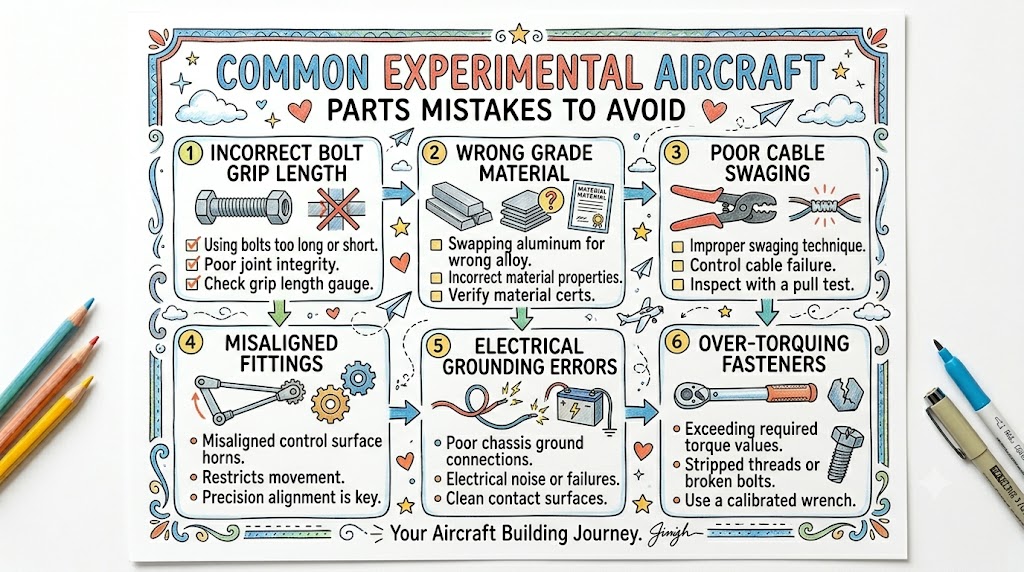
Using incorrect bolts, nuts, or washers can compromise aircraft integrity.
For example, low-grade bolts may fail under vibration stress.
Best practice: Always use aviation-approved hardware with correct ratings.
Skipping Material Strength Verification
Not verifying material strength can lead to structural weakness.
For example, using low-grade aluminum may reduce airframe durability.
Best practice: Confirm material specifications before installation.
Poor Documentation and Missing Traceability
Missing documentation can delay inspection approval.
For example, uncertified parts without serial numbers may be rejected.
Best practice: Maintain full traceability for every installed component.
Ignoring Load and Stress Ratings
Every part must meet load requirements for safe operation.
For example, control cables not rated for required tension may fail under load.
Best practice: Always check load specifications before installation.
Incorrect Installation of Control Systems
Improper installation can directly affect flight safety.
For example, misrouted control cables can restrict movement.
Best practice: Follow precise routing and installation guidelines.
Fuel System Part Mismatches
Fuel system errors can cause engine performance issues.
For example, incompatible fuel lines may lead to leaks.
Best practice: Use fuel-rated, compatible components only.
Electrical Wiring Errors
Faulty wiring is a major safety risk in experimental aircraft.
For example, incorrect connectors may cause avionics failure.
Best practice: Use aviation-grade wiring and follow schematics carefully.
Overlooking Corrosion Protection
Ignoring corrosion prevention reduces aircraft lifespan.
For example, untreated aluminum parts may corrode in humid environments.
Best practice: Apply proper coatings and storage methods.
Improper Storage of Aircraft Parts
Poor storage conditions damage sensitive components.
For example, rubber seals exposed to heat may degrade prematurely.
Best practice: Store parts in controlled, clean environments.
Not Verifying Kit Manufacturer Compatibility
Using unverified parts leads to assembly mismatches.
For example, incorrect landing gear components may not align properly.
Best practice: Always confirm compatibility with kit documentation.
Ignoring Inspection Requirements
Skipping inspections leads to safety and compliance risks.
For example, cracks in composite parts may go unnoticed.
Best practice: Inspect all parts before installation.
Delaying Replacement of Worn Components
Old parts reduce aircraft performance and safety.
For example, worn bearings can create vibration issues.
Best practice: Replace parts proactively based on condition.
Using Incorrect Tools
Wrong tools can damage components during installation.
For example, over-torquing bolts may strip threads.
Best practice: Use calibrated aviation-grade tools.
Lack of Quality Control During Sourcing
Poor sourcing leads to unreliable parts.
For example, counterfeit components may fail under stress.
Best practice: Purchase only from trusted aviation suppliers.
Correct vs Incorrect Parts Selection
| Factor | Correct Selection | Incorrect Selection |
|---|---|---|
| Safety | High | Low |
| Performance | Reliable | Unstable |
| Inspection | Approved | Rejected |
| Risk Level | Low | High |
OEM vs Non-Certified Components
| Factor | OEM Parts | Non-Certified Parts |
| Reliability | High | Uncertain |
| Compatibility | Exact | Variable |
| Safety | Strong | Risky |
| Compliance | Approved | Questionable |
Proper vs Incorrect Installation
| Factor | Proper Installation | Incorrect Installation |
| Aircraft Safety | High | Compromised |
| Performance | Optimal | Reduced |
| Maintenance | Easy | Difficult |
| Risk | Low | High |
Certified vs Non-Certified Parts
| Factor | Certified | Non-Certified |
| Documentation | Complete | Missing |
| Inspection Approval | Easy | Difficult |
| Durability | High | Low |
| Safety | Strong | Weak |
Benefits of Avoiding These Mistakes
Avoiding these mistakes helps:
- Improve aircraft safety
- Reduce build failures
- Ensure inspection readiness
- Improve structural reliability
- Prevent costly rework
- Enhance performance efficiency
- Reduce long-term maintenance issues
- Improve compliance outcomes
- Support smoother aircraft assembly
- Increase builder confidence
Practical Tips for Builders
- Always follow kit manufacturer manuals
- Verify part compatibility before purchase
- Use aviation-certified components
- Inspect all parts before installation
- Maintain full documentation records
- Store components properly
- Double-check torque and installation values
- Work with trusted suppliers only
Common Mistakes to Avoid
- Using incompatible parts
- Ignoring documentation requirements
- Poor installation practices
- Skipping inspection steps
- Choosing parts based only on price
- Using incorrect tools during assembly
FAQs
1. What are common experimental aircraft parts mistakes?
They include using incompatible parts, poor installation, and missing documentation.
2. How do I verify part compatibility?
Check kit manufacturer manuals and supplier specifications.
3. Why is documentation important?
It ensures traceability, safety compliance, and inspection approval.
4. Are aftermarket parts safe?
They can be safe if properly verified and compatible.
5. What is the biggest risk for builders?
Using incorrect or uncertified components during construction.
6. How do I avoid installation errors?
Follow manuals and use proper aviation tools.
7. Why is corrosion protection important?
It prevents long-term structural damage.
8. What tools should be used?
Only calibrated, aviation-grade tools should be used.
9. Can mixing parts cause problems?
Yes, it can lead to compatibility and safety issues.
10. How do I ensure safe sourcing?
Only purchase from trusted and verified aviation suppliers.
Conclusion
Avoiding common experimental aircraft parts mistakes is essential for building a safe, reliable, and airworthy aircraft. Every decision—from part selection to installation—directly affects performance and safety. By following manufacturer guidelines, ensuring proper documentation, and using certified components, builders can significantly reduce risks and improve build quality. A disciplined approach to aircraft construction not only prevents costly errors but also ensures long-term reliability and confidence in flight operations.

