
Introduction
Building or maintaining an experimental aircraft gives owners and builders opportunities that are not normally available with a conventional type-certificated aircraft. They may be able to customise the instrument panel, select an alternative engine, fabricate brackets, install newer avionics, modify cooling arrangements, or choose components from several specialist suppliers.
This flexibility is one of the main attractions of kit-built and amateur-built aviation. However, it also places greater responsibility on the builder or owner to confirm that every component is appropriate for its intended function.
Standard aircraft parts are generally connected to a defined aircraft design, recognised production process, approved replacement system, or documented installation. Experimental aircraft parts may come from kit manufacturers, aviation suppliers, small fabrication companies, individual builders, or general industrial sources.
The difference is therefore not simply that one component is certified and another is not. Important differences may involve design approval, manufacturing controls, documentation, traceability, installation methods, testing, inspection responsibilities, and long-term product support.
What Is an Experimental Aircraft?
An experimental aircraft is an aircraft operating under a special airworthiness category rather than a standard type-certificated category.
The word experimental does not necessarily mean that the aircraft is an unfinished prototype or that every flight is an experiment. It identifies the certification category and the operating conditions that apply to that aircraft.
Depending on the country and applicable aviation rules, experimental aircraft may include:
- Amateur-built aircraft
- Kit-built aircraft
- Research and development aircraft
- Exhibition aircraft
- Racing aircraft
- Aircraft used for market surveys
- Aircraft used for crew training
- Aircraft undergoing specific testing
- Certain light-sport or special-purpose aircraft
A large proportion of experimental aircraft are built by individuals from plans or kits for education and recreation. The builder may complete structural assembly, electrical wiring, engine installation, avionics integration, interior work, and other construction tasks.
The exact categories, privileges, operating limitations, inspection rules, and maintenance permissions differ between aviation authorities. Owners must follow the rules and operating limitations issued for their individual aircraft.
What Is a Type-Certificated Aircraft?
A type-certificated aircraft is built according to a design that has been evaluated and accepted by the relevant aviation authority.
The approved design normally identifies or controls important elements such as:
- Structural configuration
- Engine and propeller combinations
- Flight-control systems
- Fuel systems
- Electrical systems
- Instruments and avionics
- Landing gear
- Approved materials
- Operating limitations
- Maintenance instructions
- Replacement components
- Approved modifications
A type certificate does not mean that an aircraft can never be changed. However, modifications normally need to follow an accepted approval pathway and use suitable technical data.
Parts installed on a type-certificated aircraft generally must be eligible for that aircraft, suitable for the intended installation, and supported by the required documentation.
What Are Experimental Aircraft Parts?
The phrase experimental aircraft parts is commonly used to describe components intended for kit-built, amateur-built, custom, or other experimental aircraft.
These parts may include:
- Components supplied with an aircraft kit
- Builder-fabricated brackets and fittings
- Custom-machined metal parts
- Composite panels and fairings
- Non-certified electronic flight displays
- Alternative engine components
- Custom electrical systems
- Modified fuel-system components
- Experimental avionics
- Purpose-built engine mounts
- Custom instrument panels
- Commercial off-the-shelf components
Not every component installed in an experimental aircraft is necessarily experimental.
A kit aircraft may use a certified engine, recognised aviation hardware, an approved propeller, established avionics, or components originally designed for type-certificated aircraft. The complete installation, however, must still be evaluated for the particular experimental aircraft.
What Are Standard Aircraft Parts?
The expression standard aircraft parts can create confusion because it is used in different ways.
In casual conversation, people may use it to describe any commonly used aviation component. In a regulatory context, however, a standard part may have a narrower definition involving an established specification published by a recognised standards organisation.
Examples can include certain:
- Bolts
- Nuts
- Washers
- Rivets
- Screws
- Pins
- Electrical terminals
- Hose fittings
- Bearings
Standard aircraft parts should not be confused with all approved replacement parts.
An approved replacement component may be produced by the original aircraft manufacturer or another authorised producer and may have a specific part number and installation eligibility. It is not necessarily a standard part in the strict regulatory meaning.
For this discussion, standard aircraft parts broadly refers to documented components intended for type-certificated aircraft and produced or supplied through recognised aviation channels.
Experimental Aircraft Parts vs Standard Aircraft Parts
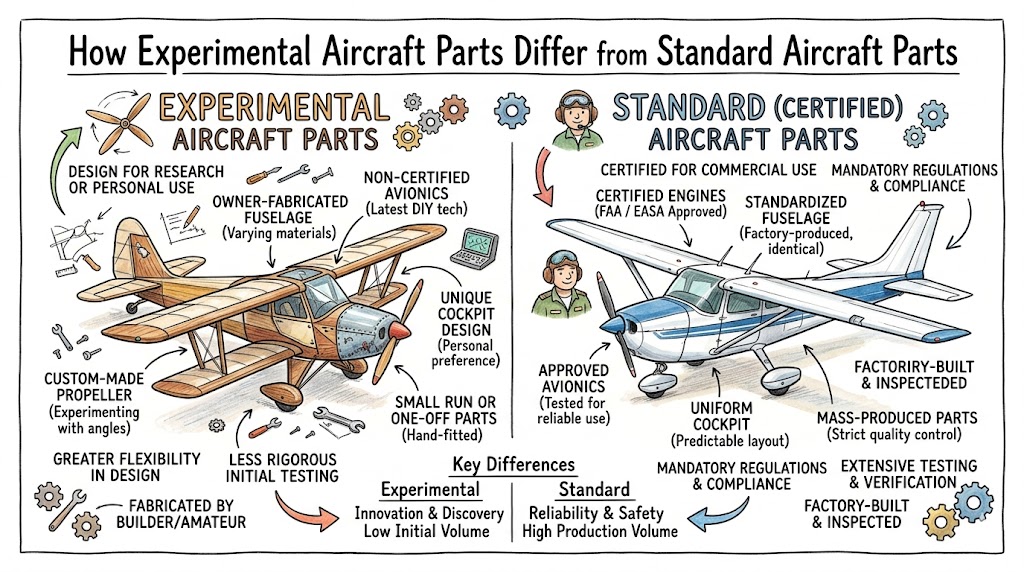
| Factor | Experimental Aircraft Parts | Standard Aircraft Parts |
|---|---|---|
| Intended application | Experimental, kit-built, custom, or builder-defined aircraft | Defined type-certificated aircraft applications |
| Design flexibility | Generally greater | Controlled by approved design data |
| Approval pathway | Depends on aircraft category and jurisdiction | Usually connected to recognised production or modification approval |
| Manufacturing control | Can vary significantly | Usually follows documented production controls |
| Documentation | May range from detailed to limited | Normally more structured and formal |
| Traceability | Depends on component and supplier | Commonly expected for eligible aviation parts |
| Installation basis | Kit plans, supplier instructions, accepted practices, or engineering evaluation | Approved manuals, parts catalogues, or modification data |
| Modification freedom | Broader in many cases | More restricted |
| Inspection responsibility | Often heavily dependent on builder and owner knowledge | Supported by an established maintenance system |
| Cost | May offer more pricing flexibility | Can cost more due to approval and documentation requirements |
| Supplier choice | Often wider | Usually limited to eligible sources |
| Long-term support | Depends on supplier or builder records | Frequently supported by a manufacturer or approval holder |
1- Regulatory Approval
One of the greatest differences concerns how the component becomes acceptable for installation.
A replacement part for a type-certificated aircraft normally needs to conform to the aircraft’s approved design or be installed under an accepted modification process. The installer may need to confirm its part number, condition, documentation, eligibility, and applicability.
Experimental aircraft often provide greater freedom to select or fabricate components. This does not mean that builders can install anything without evaluation.
The aircraft must still comply with:
- Applicable aviation regulations
- Its operating limitations
- Airworthiness requirements
- Inspection requirements
- Aircraft-specific documentation
- Any limitations imposed by the aviation authority
- Safe aviation construction and maintenance practices
The owner must also consider how a modification affects the aircraft’s operating status. A significant change may require additional inspection, testing, documentation, or a return to a defined flight-test programme.
2- Design and Modification Flexibility
Experimental aviation allows builders to make design choices that might require formal engineering and approval processes on a type-certificated aircraft.
A builder may choose to:
- Create a custom instrument panel
- Install an alternative electronic display
- Select different switches and circuit protection
- Modify a cabin ventilation arrangement
- Fabricate equipment mounting brackets
- Install a different engine option
- Develop a custom cooling system
- Use an alternative lighting system
- Create aerodynamic fairings
- Change the interior configuration
This flexibility can support innovation and personalisation. It can also introduce unintended problems.
A seemingly minor change may affect:
- Structural loads
- Aircraft weight
- Centre of gravity
- Electrical demand
- Cooling airflow
- Engine temperatures
- Control movement
- Vibration
- Aerodynamic behaviour
- Pilot visibility
- Emergency access
- Maintenance accessibility
A modification should therefore be evaluated as part of the complete aircraft system rather than as an isolated improvement.
3- Manufacturing Standards and Quality Control
Standard aircraft components are generally manufactured under controlled production processes. These processes may include defined materials, tooling, tolerances, inspections, testing, marking, and recordkeeping.
Experimental aircraft parts can come from many sources:
- Established kit manufacturers
- Specialist aviation suppliers
- Small engineering companies
- Local machine shops
- Composite fabrication businesses
- Individual aircraft builders
- General industrial suppliers
- Second-hand aircraft-parts sellers
Some experimental aircraft suppliers maintain excellent design and manufacturing controls. Others may offer limited technical information or quality documentation.
Buyers should evaluate:
- Material specifications
- Dimensional accuracy
- Machining quality
- Welding quality
- Heat treatment
- Surface protection
- Composite layup quality
- Fastener selection
- Critical tolerances
- Inspection methods
- Supplier reputation
A component that looks professionally finished may still be unsuitable if the material, dimensions, heat treatment, or production method is incorrect.
4- Documentation and Traceability
Traceability is the ability to determine where a part came from, who manufactured it, what specifications apply, and what happened to it before installation.
Useful aircraft-parts documentation can include:
- Manufacturer name
- Part number
- Serial number
- Purchase invoice
- Material certificate
- Production record
- Inspection report
- Maintenance history
- Service information
- Installation instructions
- Previous aircraft details
- Removal records
Standard aircraft parts commonly have structured documentation because eligibility and condition must be demonstrated before installation.
Documentation for experimental parts can vary. A kit manufacturer may provide detailed drawings, part numbers, manuals, revisions, and service notices. A custom component made by an individual builder may have little more than a sketch and a material receipt.
Builders should create and preserve their own records when formal documentation is limited.
Good records help with:
- Future inspections
- Troubleshooting
- Replacement
- Maintenance planning
- Aircraft resale
- Insurance discussions
- Identifying service concerns
- Communicating with future owners
5- Compatibility and Eligibility
Physical fit does not prove that a component is suitable for aviation use.
A bolt may fit through a hole but have the wrong strength, grip length, thread configuration, corrosion resistance, or temperature capability. An electrical switch may work during a ground test but be unable to handle the required current or vibration environment.
Compatibility should include:
- Correct dimensions
- Material strength
- Fatigue resistance
- Temperature limits
- Vibration resistance
- Electrical voltage
- Electrical current
- Pressure rating
- Chemical compatibility
- Fuel compatibility
- Corrosion resistance
- Environmental sealing
- Structural loading
- Weight
- Balance
- Interaction with connected systems
Consider a hose that physically connects to an aircraft fuel system. It may still be unsuitable if its internal material reacts with the fuel, if it cannot withstand the operating temperature, or if its pressure rating is too low.
Every component must be evaluated according to its actual operating environment.
6- Installation Requirements
Experimental aircraft parts may be installed using:
- Kit plans
- Builder manuals
- Manufacturer instructions
- Component installation guides
- Accepted aviation practices
- Engineering advice
- Aircraft-specific drawings
Parts on type-certificated aircraft are generally installed according to controlled information such as:
- Maintenance manuals
- Illustrated parts catalogues
- Structural repair manuals
- Wiring manuals
- Service instructions
- Approved modification data
- Applicable airworthiness information
Regardless of the aircraft category, correct installation is essential.
Important installation details can include:
- Fastener type
- Torque values
- Safety locking
- Edge distance
- Hole quality
- Wire routing
- Hose routing
- Heat clearance
- Control clearance
- Bonding and grounding
- Protection from abrasion
- Protection from vibration
- Fluid sealing
- Alignment
- Accessibility for inspection
Using an appropriate component does not guarantee a safe result when the installation itself is poor.
7- Inspection and Maintenance Responsibility
Experimental aircraft owners often need detailed knowledge of how the aircraft was built and modified.
A future mechanic may not have a manufacturer’s complete maintenance programme for every custom installation. Builder records, photographs, drawings, and logbook entries can become essential.
Inspection activities may include:
- Condition inspections
- Pre-flight inspections
- Post-maintenance checks
- Control-system inspections
- Electrical inspections
- Leak checks
- Fastener inspections
- Corrosion inspections
- Functional tests
- Follow-up inspections after modifications
Maintenance and inspection privileges depend on the aircraft category, the work involved, the individual’s qualifications, and the applicable jurisdiction.
A builder may be permitted to perform certain work while still needing a qualified person to conduct or approve a required inspection. Owners should never assume that experimental status gives unrestricted maintenance or inspection authority.
8- Testing and Operational Evaluation
New components and major modifications may require systematic evaluation before normal operation.
Testing can include:
- Detailed visual inspection
- Independent inspection of critical work
- Control movement checks
- Electrical functional checks
- Ground engine operation
- Leak detection
- Temperature monitoring
- Vibration observation
- Brake testing
- Instrument verification
- Progressive operational evaluation
- Follow-up inspections
Builders should avoid introducing many untested changes at the same time. When several systems are modified together, diagnosing a problem becomes more difficult.
Flight evaluation must follow the aircraft’s operating limitations and applicable regulations. It should be planned conservatively and supported by appropriately qualified aviation professionals.
9- Cost Differences
Experimental aircraft parts may sometimes cost less than components produced for type-certificated aircraft.
Possible reasons include lower expenses related to:
- Certification
- Production approval
- Formal testing
- Documentation
- Distribution
- Inventory control
- Regulatory compliance
- Product support
However, a lower purchase price does not always produce a lower total cost.
Additional expenses may include:
- Custom machining
- Engineering review
- Installation modifications
- Rework
- Additional inspections
- Special tools
- Replacement after incompatibility
- Testing
- Shipping
- Limited warranty coverage
- Downtime
A part should be evaluated according to total ownership and installation cost, not only its advertised price.
10- Availability and Supplier Support
Experimental aircraft builders may have access to a broad selection of modern components.
This can make it easier to find:
- Compact avionics
- Lightweight instruments
- Digital engine monitors
- Custom panels
- Composite parts
- Alternative engine accessories
- Specialised lighting
- Builder-friendly wiring products
However, specialist suppliers may operate at low production volumes.
Potential challenges include:
- Long lead times
- Limited spare inventory
- Product discontinuation
- Supplier closure
- Design revisions
- Incomplete documentation
- Limited technical support
- Difficulty replacing custom components
Before selecting a critical part, builders should consider whether the same or an equivalent component will be available several years later.
Examples of Experimental Aircraft Components
Structural Components
Experimental structural parts may include:
- Wing ribs
- Spar components
- Brackets
- Fittings
- Bulkheads
- Composite panels
- Fairings
- Landing gear parts
- Control-system mounts
These components may carry significant loads, making material selection, fabrication accuracy, and inspection especially important.
Engine and Propulsion Components
Examples include:
- Engine mounts
- Cooling ducts
- Exhaust components
- Fuel lines
- Fuel pumps
- Oil-system parts
- Alternative engine accessories
- Air-intake components
- Propeller-related equipment
Engine installations involve heat, vibration, fuel, oil, electrical power, and structural loads. Changes in one area can influence several other systems.
Avionics and Electrical Components
Experimental aircraft commonly use:
- Electronic flight displays
- Engine monitoring systems
- Sensors
- Wiring systems
- Circuit breakers and fuses
- Switch panels
- Communication radios
- Navigation equipment
- Autopilot components
- Custom instrument panels
The availability of modern non-certified avionics is a major advantage of experimental aviation. Builders must still evaluate electrical loads, wiring protection, grounding, software limitations, sensor placement, and installation quality.
Cabin and Interior Components
These can include:
- Seats
- Harnesses
- Interior panels
- Ventilation outlets
- Storage compartments
- Control grips
- Cabin lighting
- Soundproofing material
Interior components should be evaluated for secure attachment, interference with controls, weight, flammability characteristics, and emergency access.
Advantages of Experimental Aircraft Parts
Greater Customisation
Builders can configure the aircraft around personal preferences, mission requirements, and available technology.
Access to Modern Technology
Experimental aircraft owners may be able to adopt new displays, engine monitors, sensors, and electronic systems without waiting for aircraft-specific approval programmes.
Wider Supplier Choice
Components may be available from kit manufacturers, specialist aviation businesses, engineering firms, and selected industrial suppliers.
Potential Cost Flexibility
Builders may compare several solutions and select components that balance performance, reliability, support, and price.
Custom Fabrication
Unique brackets, panels, fairings, and mounting solutions can be created for individual aircraft configurations.
Support for Special Missions
Custom components can help adapt an aircraft for touring, training, research, competition, backcountry operations, or other specialised uses.
These advantages depend on appropriate design, materials, fabrication, installation, documentation, testing, and inspection.
Limitations and Risks
Experimental aircraft parts may present challenges such as:
- Inconsistent manufacturing quality
- Limited traceability
- Unclear compatibility
- Incomplete instructions
- Reduced supplier support
- Unverified materials
- Installation errors
- Difficulty obtaining replacements
- Greater owner responsibility
- Uncertain second-hand history
- Maintenance difficulties for future owners
- Possible effects on resale or insurance
These risks do not mean experimental parts are automatically unsafe. They mean that the owner may need to perform more investigation before purchase and installation.
How to Evaluate an Experimental Aircraft Part
Confirm the Intended Application
Determine whether the component was specifically designed for the aircraft, adapted from another model, or intended as a general-purpose part.
Identify the Manufacturer
Research who designed and produced the component. Look for clear contact information, technical knowledge, product support, and consistent manufacturing.
Review the Materials
Confirm the material type, strength, thickness, treatment, and environmental suitability where these factors are important.
Examine Workmanship
Inspect machining, welds, threads, holes, surface finish, composite construction, protective coatings, and overall condition.
Request Installation Instructions
A suitable part should be supported by enough information to install and inspect it correctly.
Check Dimensions and Ratings
Confirm dimensions, tolerances, electrical ratings, pressure ratings, temperature limitations, and load capability.
Review Service Experience
Ask whether the design has been used in similar aircraft and whether any service problems or revisions have been reported.
Consider Replacement Availability
Determine whether the supplier can provide replacement units, repair parts, or technical assistance.
Consult Qualified Professionals
Seek support from the kit manufacturer, an experienced aircraft builder, a qualified mechanic, or an aeronautical engineer when the component affects a critical system.
Preserve Records
Retain invoices, instructions, photographs, drawings, material records, and installation details.
Questions to Ask an Aircraft-Parts Supplier
Before purchasing, consider asking:
- Was this part designed for my aircraft model?
- What material was used?
- Are material records available?
- What loads or operating conditions was it designed for?
- Has the design been revised?
- Are complete installation instructions included?
- Does installation require additional fabrication?
- What inspections are recommended?
- Are special tools required?
- Is technical support available?
- Are replacement parts likely to remain available?
- Have service concerns been reported?
- What warranty or return terms apply?
- Can the supplier provide relevant usage information?
A reliable supplier should be willing to explain the component’s intended use and limitations.
Common Mistakes to Avoid
Choosing Parts Only by Price
The least expensive option may create higher installation, inspection, replacement, or downtime costs.
Assuming Physical Fit Means Compatibility
A component can fit correctly while having unsuitable strength, temperature, pressure, electrical, or chemical characteristics.
Using Incorrect Hardware
General hardware may look similar to aviation hardware while having different materials, tolerances, or strength.
Mixing Incompatible Metals
Certain metal combinations can accelerate corrosion, particularly in moist or salty environments.
Ignoring Heat and Vibration
Components installed near engines, exhaust systems, pumps, or rotating machinery may require special protection.
Failing to Document Modifications
Poor records make future inspections, maintenance, troubleshooting, and resale more difficult.
Installing Without Instructions
Missing or incomplete instructions increase the risk of incorrect torque, routing, alignment, clearance, or protection.
Making Too Many Changes at Once
Multiple untested changes make it difficult to identify the cause of a new problem.
Ignoring Weight and Balance
Even small component changes can accumulate and alter aircraft weight or centre of gravity.
Buying Used Parts With Unknown History
A component may have hidden damage, excessive operating time, improper storage, or an unknown removal reason.
Copying Another Builder’s Modification
A solution that works on one aircraft may not be appropriate for another because of differences in configuration, workmanship, weight, systems, or operating environment.
Using Standard Parts in Experimental Aircraft
Experimental aircraft can often incorporate parts also used in type-certificated aircraft.
Examples may include:
- Engines
- Propellers
- Instruments
- Fasteners
- Wheels
- Brakes
- Fuel-system hardware
- Control-system hardware
- Avionics
- Electrical components
Builders may choose these parts because they offer:
- Established documentation
- Known service history
- Better traceability
- Familiar maintenance procedures
- Easier replacement
- Wider technical support
- Greater confidence among future maintainers
However, using an approved or certified part does not automatically make the entire installation approved, compatible, or safe.
The mount, wiring, plumbing, control connection, cooling arrangement, and surrounding structure must also be appropriate.
When Custom Experimental Parts May Be Appropriate
Custom components may be considered when:
- The aircraft has a unique configuration
- An original kit part is no longer available
- A special instrument-panel layout is needed
- An alternative engine is installed
- Cooling arrangements require modification
- A research project needs specialised equipment
- An aerodynamic fairing is being developed
- A cabin feature requires a custom mounting solution
Safety-critical custom components require disciplined design and evaluation.
The process may involve:
- Load analysis
- Material selection
- Accurate fabrication
- Independent inspection
- Ground testing
- Progressive operational testing
- Follow-up inspection
- Detailed documentation
The freedom to fabricate a part should never replace the responsibility to establish that it is suitable.
Frequently Asked Questions
1- What is an experimental aircraft part?
It is a component used in an aircraft operating in an experimental category. The part may be supplied by a kit manufacturer, fabricated by the builder, purchased from an aviation supplier, or adapted for a custom installation.
2- Are experimental aircraft parts legal to use?
They may be permitted when used according to the aircraft’s certification basis, operating limitations, and applicable regulations. Requirements vary by jurisdiction and by the nature of the modification.
3- Are experimental aircraft parts less safe?
Not automatically. Safety depends on design, materials, manufacturing quality, installation, inspection, testing, documentation, and operation. A poorly selected standard component can also create risks.
4- Can certified parts be installed in an experimental aircraft?
Yes, experimental aircraft frequently use components also found in certified aircraft. The builder must still verify that the part and complete installation are suitable for the experimental aircraft.
5- Can automotive parts be used in a kit aircraft?
Some builders use selected automotive-derived components, particularly in alternative engine installations. Suitability must be evaluated for aviation loads, vibration, temperature, pressure, reliability, and environmental conditions.
6- Do experimental aircraft parts need documentation?
Documentation may not always follow the same format required for type-certificated aircraft, but good records remain extremely important. Builders should preserve part details, instructions, invoices, specifications, and installation records.
7- Who can install parts on an experimental aircraft?
The answer depends on the aircraft category, the person’s qualifications, the type of work, and local regulations. Installation authority should not be confused with authority to perform or approve a required inspection.
8- How should custom parts be inspected?
Inspection should consider material, dimensions, workmanship, attachment, alignment, clearances, loads, corrosion protection, and interaction with nearby systems. Critical parts may require specialist or engineering evaluation.
9- Are experimental aircraft parts cheaper?
Some are less expensive because they do not carry the same approval and production costs. Custom fabrication, installation work, testing, rework, shipping, and limited support can increase the total cost.
10- How can buyers confirm component compatibility?
They should compare the part’s dimensions, materials, ratings, intended application, operating environment, and installation requirements with the aircraft design. Kit-manufacturer or qualified professional advice may be necessary.
11- Can used parts be installed in an experimental aircraft?
Used components may be considered, but their identity, condition, history, storage, previous use, and suitability must be evaluated. Unknown history increases risk, especially for critical components.
12- Do experimental aircraft modifications need to be recorded?
Changes should be documented in the appropriate aircraft records. Significant modifications may also trigger inspection, testing, or operating requirements depending on the aircraft and jurisdiction.
13- What happens if a kit manufacturer stops supporting a part?
The owner may need to locate remaining stock, identify an equivalent component, repair the original, or develop a replacement. Accurate drawings and installation records make this process easier.
14- Should builders consult an engineer before modifying critical systems?
Professional engineering support is advisable when a change affects primary structure, flight controls, propulsion, fuel systems, landing gear, or other safety-critical areas. Builder experience alone may not be sufficient.
Conclusion
Experimental aircraft parts differ from standard aircraft parts mainly in their approval pathway, design flexibility, production controls, documentation, traceability, installation basis, and inspection responsibility. Experimental aviation gives builders valuable freedom to customise aircraft, incorporate modern technology, fabricate special components, and develop solutions for unique missions. That freedom also requires disciplined technical decision-making.
A part should never be selected only because it fits, looks well made, or costs less. Builders and owners should evaluate its intended function, material, workmanship, operating environment, compatibility, instructions, supplier support, inspection needs, and effect on the complete aircraft. Good documentation is equally important because it supports maintenance, troubleshooting, future modifications, inspections, and resale.
Before purchasing, fabricating, or installing a safety-critical component, owners should follow the aircraft’s plans and operating limitations, consult the kit or component manufacturer, use recognised aviation practices, and obtain qualified technical assistance when necessary.

