
Introduction
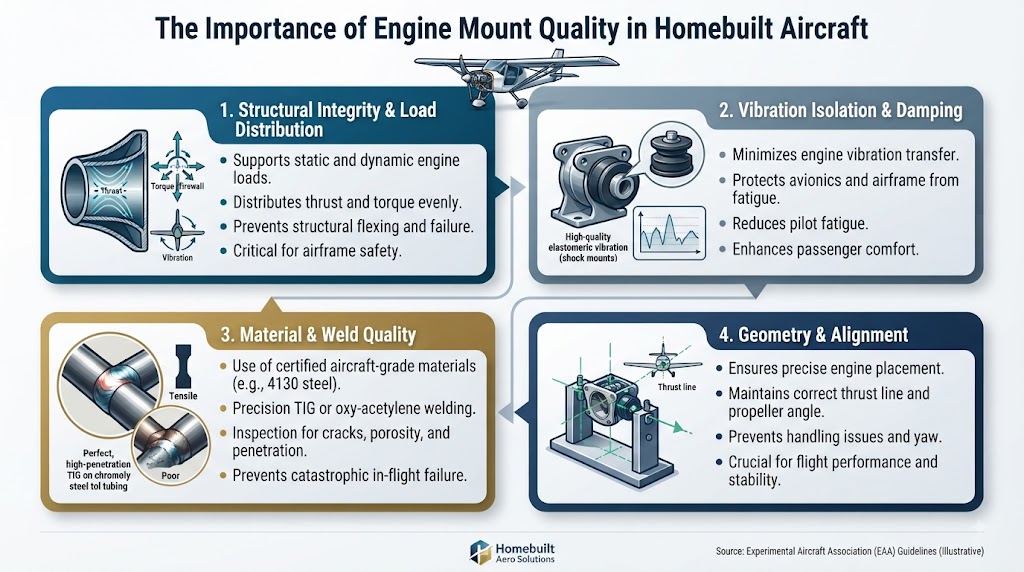
Building a homebuilt aircraft requires careful attention to every component that contributes to structural integrity, engine performance, and operational reliability. Among these components, the engine mount has a particularly important role because it connects the powerplant to the aircraft structure. It must support the engine while accommodating the forces and vibration generated during operation. A mount that is poorly designed, incorrectly installed, damaged, or unsuitable for the aircraft configuration can create concerns that extend beyond the mounting structure itself. For builders and owners of experimental aircraft, understanding engine mount quality is therefore an important part of responsible aircraft construction and maintenance.
What Is an Engine Mount?
An aircraft engine mount is the structural system that connects the engine to the airframe.
Its primary purpose is to securely support the powerplant while transferring relevant forces between the engine and aircraft structure.
During normal operation, an engine mount can be exposed to different types of loads associated with:
- Engine weight
- Thrust
- Torque
- Vibration
- In-flight loads
- Ground movement
- Landing loads
- Changes in engine operating conditions
The engine mount also has to maintain the engine in the intended position relative to the aircraft.
That positioning can affect areas such as propeller alignment, cowling clearance, exhaust routing, cooling arrangements, and other surrounding systems.
For a homebuilt aircraft, the engine mount should therefore be viewed as an important structural component rather than simply a bracket used to hold the engine in place.
Why Engine Mount Quality Matters in Homebuilt Aircraft
Homebuilt aircraft offer builders considerable flexibility, but that flexibility also creates responsibility.
The engine, mount, airframe, propeller, accessories, and surrounding systems must work together as an appropriate configuration.
A high-quality engine mount can contribute to:
- Structural integrity
- Engine stability
- Appropriate alignment
- Vibration management
- Airframe protection
- Component longevity
- Maintenance reliability
The opposite can also create concerns.
A mount that is unsuitable for the aircraft or incorrectly installed may experience excessive vibration, unusual loading, premature wear, or structural damage.
This is why builders should consider engineering suitability, manufacturing quality, installation requirements, and long-term inspection when selecting an engine mount.
Key Functions of a Quality Engine Mount
Supporting the Engine Securely
The most obvious function of an engine mount is supporting the engine.
However, this responsibility becomes more significant once the aircraft is operating.
The mount must remain secure while the aircraft experiences:
- Engine operation
- Takeoff
- Landing
- Maneuvering
- Ground movement
- Turbulence
The attachment system must be appropriate for the specific aircraft and engine configuration.
A mount should never be selected simply because it appears physically compatible.
Managing Engine Vibration
Aircraft engines naturally produce vibration.
Some vibration is a normal characteristic of piston engine operation, while excessive or abnormal vibration may indicate a problem involving the engine, propeller, mounting system, or another component.
The engine mount and its associated mounting system influence how vibration is transmitted between the powerplant and airframe.
Excessive vibration can contribute to wear involving:
- Fasteners
- Instruments
- Avionics
- Exhaust components
- Accessories
- Airframe structures
- Engine components
A properly considered mounting system can help manage these effects, but an engine mount does not eliminate engine vibration by itself.
Maintaining Engine Alignment
Engine positioning is another important consideration.
The engine must occupy its intended position relative to the aircraft structure and associated systems.
Alignment can affect:
- Propeller positioning
- Thrust direction
- Cowling clearance
- Exhaust routing
- Cooling arrangements
- Accessory installation
Even relatively small installation changes can have consequences for surrounding systems.
Builders should therefore follow the applicable aircraft plans, technical documentation, engine information, and appropriate engineering guidance when establishing engine position.
Handling Structural Loads
An engine mount is exposed to more than the static weight of an engine.
During operation, the system may experience forces associated with thrust, torque, vibration, flight loads, ground loads, and landing conditions.
The actual loads depend on the aircraft and engine configuration.
This is why engine mount selection should be based on appropriate design information rather than assumptions based solely on physical appearance or dimensions.
Protecting the Airframe
The engine mount transfers forces into the aircraft structure.
That makes the relationship between the mount and surrounding airframe components especially important.
Incorrect mounting, unsuitable attachment points, or inappropriate modifications may introduce unintended loads into areas that were not designed for them.
A good installation therefore considers not only the mount itself but also the structure to which it is attached.
Important Engine Mount Quality Factors
Material Quality
The material used in an engine mount can influence its strength, durability, corrosion resistance, and fatigue behavior.
However, there is no universally correct material for every homebuilt aircraft.
Material selection should be based on the aircraft design, engine requirements, applicable technical documentation, and appropriate engineering considerations.
Builders should avoid selecting materials simply because they are inexpensive, readily available, or appear sufficiently strong.
Manufacturing Quality
Even an appropriately designed mount can present problems if it is manufactured poorly.
Quality considerations can include:
- Accurate dimensions
- Correct attachment points
- Consistent fabrication
- Appropriate surface condition
- Proper hardware interfaces
- Suitable finishing and protection
Manufacturing quality becomes particularly important because engine mounts experience repeated loading during their service life.
Weld Quality
Many engine mounts incorporate welded structures.
Weld quality can have an important influence on structural reliability.
Potential concerns include:
- Poor weld formation
- Incomplete joining
- Surface defects
- Cracking
- Distortion
- Inappropriate fabrication practices
Builders should rely on appropriate manufacturing and inspection practices rather than attempting to judge structural weld quality based only on appearance.
Corrosion Resistance
Corrosion can gradually reduce the condition of an aircraft component.
Engine compartments can be exposed to moisture, temperature changes, contaminants, and other environmental factors.
Appropriate surface protection and regular inspection can help identify corrosion before it becomes a more serious concern.
Particular attention should be paid to areas where moisture or contamination may accumulate.
Hardware Compatibility
Fasteners and related hardware are small components, but their importance should not be underestimated.
Builders should use hardware appropriate to the aircraft design and applicable documentation.
This includes consideration of:
- Bolts
- Nuts
- Washers
- Bushings
- Attachment components
A fastener that physically fits a hole is not necessarily an appropriate structural fastener.
Substituting hardware without understanding its intended application can introduce unnecessary risk.
Engine Mount Vibration and Fatigue
Vibration deserves particular attention in aircraft engine mounting systems because it involves repeated loading.
A component can appear acceptable during a basic visual inspection while still experiencing fatigue-related concerns over time.
Repeated loads can contribute to:
- Cracks
- Hardware loosening
- Wear
- Structural deformation
- Component fatigue
The presence of unusual vibration should therefore not be dismissed simply because the aircraft remains operational.
Changes in vibration characteristics can be an indication that something in the engine, propeller, mount, or related systems needs further investigation.
Builders and owners should follow appropriate maintenance and inspection procedures when unusual vibration is detected.
Engine Mount Inspection
Regular inspection is an important part of maintaining a homebuilt aircraft.
Subject to the aircraft’s applicable documentation and qualified maintenance practices, inspection areas can include:
- Cracks
- Corrosion
- Deformation
- Loose fasteners
- Damaged bushings
- Unusual wear
- Weld condition
- Movement
- Vibration-related damage
- Damage to protective coatings
A visual inspection can provide useful information, but it does not necessarily reveal every type of structural problem.
If there is evidence of cracking, deformation, abnormal movement, or other structural concerns, the issue should be evaluated appropriately before continued operation.
Common Engine Mount Problems in Homebuilt Aircraft
1. Incorrect Engine Alignment
An incorrectly positioned engine can create issues involving propeller alignment, cowling clearance, exhaust routing, and surrounding systems.
Alignment should follow the aircraft’s applicable design information.
2. Poor-Quality Fabrication
Inconsistent dimensions, inadequate fabrication, or poor workmanship can reduce confidence in the structural suitability of a mount.
3. Weld Defects
Defective or damaged welds may become more significant when subjected to repeated engine vibration and operational loads.
4. Corrosion
Corrosion can gradually affect the condition of structural components and should not be ignored.
5. Loose or Incorrect Hardware
Incorrect hardware or hardware that has become loose can affect the security of the engine mounting system.
6. Worn Mounting Bushings
Mounting bushings can deteriorate over time and may affect vibration behavior or engine positioning.
7. Cracks or Fatigue Damage
Repeated loading can contribute to fatigue-related damage.
Cracks should always receive appropriate attention rather than being treated as minor cosmetic defects.
8. Excessive Vibration
Unexpected or increasing vibration can indicate a problem that requires investigation.
9. Structural Interference
The engine mount must provide appropriate clearance for surrounding components.
Interference involving the mount, engine, exhaust, cowling, wiring, or other systems can create operational concerns.
10. Improper Modifications
Changing the engine or mounting arrangement without appropriate engineering evaluation can alter the loads, alignment, vibration behavior, and overall aircraft configuration.
Engine Mount Installation Considerations
Engine mount installation should be approached as an important aircraft construction task.
Builders should consider:
Aircraft Design Compatibility
The mount should be appropriate for the specific aircraft configuration.
Engine Compatibility
The engine and mount combination should be evaluated together rather than independently.
Mounting Points
Attachment locations must correspond with the aircraft’s design and structural requirements.
Alignment
Engine positioning should follow the applicable aircraft plans and technical information.
Hardware
Correct hardware should be used according to the applicable documentation.
Clearances
The installation should provide appropriate clearance around the engine, mount, exhaust, cowling, wiring, fuel lines, oil lines, and other components.
Documentation
Builders should maintain relevant documentation for the engine mount and installation.
Structural modifications should receive appropriate technical or engineering review where necessary.
Choosing an Engine Mount for a Homebuilt Aircraft
Selecting an engine mount should involve more than comparing prices.
Aircraft Compatibility
First determine whether the mount is appropriate for the specific aircraft configuration.
Engine Compatibility
Confirm that the mount is suitable for the particular engine installation.
Structural Design
Consider the design basis and supporting technical information.
Manufacturing Quality
Look at fabrication quality, welds, material information, and overall construction.
Documentation
Technical documentation can help builders understand installation requirements and limitations.
Maintenance Requirements
Consider whether the mount can be inspected effectively and whether relevant replacement components are available.
Professional Review
If a builder intends to change the original engine or mounting configuration, appropriate professional or engineering review should be considered before making structural changes.
Engine Mount Quality and Aircraft Reliability
An engine mount is only one component in a larger aircraft system, but its condition can influence overall reliability.
A suitable and properly maintained mount can support:
- Stable engine installation
- Appropriate vibration management
- Airframe integrity
- Component durability
- Easier maintenance
- Reliable operation
Engine mount quality should therefore be considered alongside engine condition, propeller balance, airframe structure, cooling, exhaust systems, fuel systems, and other aircraft components.
A strong aircraft installation depends on the interaction of all these systems.
Engine Mounts and Homebuilt Aircraft Modifications
One of the advantages of homebuilt aircraft is the ability to configure an aircraft according to a builder’s goals.
However, modifications can change more than one component.
Changing an engine may affect:
- Weight
- Balance
- Vibration
- Structural loads
- Cooling
- Exhaust routing
- Cowling fit
- Engine alignment
- Mounting requirements
A different engine may therefore require more than a different mounting bracket.
Any significant structural modification should be approached carefully and supported by appropriate technical documentation and engineering evaluation where applicable.
Builders should not assume that a component from another aircraft is automatically suitable simply because the engines appear similar.
How Poor Engine Mount Quality Can Affect Other Aircraft Systems
Engine mount issues can sometimes extend beyond the mount itself.
Potentially affected systems may include:
Propeller System
Incorrect engine positioning or excessive vibration can influence the propeller system.
Exhaust System
Movement or alignment problems may create clearance concerns.
Cooling System
Engine positioning can influence the relationship between cooling components and the engine installation.
Fuel and Oil Lines
Unexpected movement or poor clearance can place additional stress on connected lines.
Electrical Wiring
Vibration or inadequate routing can contribute to wear.
Avionics
Excessive vibration may affect sensitive equipment.
Cowling
Improper engine positioning can create clearance or fit problems.
Firewall and Airframe
The engine mount transfers loads into the surrounding structure, making structural compatibility important.
Engine Mount Maintenance Best Practices
Builders and owners should develop maintenance practices appropriate to their specific aircraft.
Important principles include:
- Follow applicable aircraft documentation
- Conduct appropriate inspections
- Monitor changes in vibration
- Check for corrosion
- Inspect mounting hardware
- Examine bushings
- Look for cracks or deformation
- Maintain accurate maintenance records
- Investigate unusual noises or movement
- Address suspected structural problems before further operation when appropriate
Inspection intervals should be based on the aircraft’s applicable maintenance information rather than a generic schedule.
Common Mistakes Builders Should Avoid
1. Choosing a Mount Based Only on Price
The least expensive component is not necessarily the most appropriate choice for an aircraft.
2. Assuming Physical Fit Means Structural Compatibility
A mount that attaches to the engine does not automatically mean it is appropriate for the airframe.
3. Ignoring Engine Weight and Configuration
Different engines can create different installation requirements.
4. Using Unsuitable Hardware
Correct structural hardware matters even when components appear interchangeable.
5. Overlooking Vibration
Persistent or unusual vibration should be investigated rather than ignored.
6. Failing to Inspect Welds
Welded structures should receive appropriate inspection throughout their service life.
7. Ignoring Corrosion
Surface deterioration can become a more significant structural concern over time.
8. Modifying the Mount Without Proper Evaluation
Structural modifications can affect loads, vibration, alignment, and airframe integrity.
9. Neglecting Documentation
Clear technical documentation helps builders understand installation and maintenance requirements.
10. Continuing Operation Despite Suspected Structural Damage
Cracks, significant deformation, unusual movement, or other structural concerns should receive appropriate evaluation before continued operation.
Quality Engine Mount vs Low-Quality or Unsuitable Mount
| Factor | Quality Engine Mount | Poor or Unsuitable Mount |
|---|---|---|
| Aircraft compatibility | Appropriately evaluated | May be uncertain |
| Manufacturing | Consistent and controlled | Potentially inconsistent |
| Weld quality | Appropriately fabricated and inspected | May contain defects |
| Hardware | Correct and compatible | Incorrect or unsuitable |
| Alignment | Properly established | May be inaccurate |
| Vibration management | Considered in the design | May contribute to excessive vibration |
| Corrosion protection | Appropriate protection and inspection | May deteriorate prematurely |
| Documentation | Clear technical information | Limited or unclear |
| Maintenance | Accessible for inspection | May be difficult to assess |
| Structural confidence | Supported by appropriate design information | Uncertain |
Step-by-Step Engine Mount Evaluation Framework
Step 1: Identify the Aircraft
Determine the exact aircraft configuration and applicable plans.
Step 2: Identify the Engine
Confirm the engine model, configuration, and relevant installation requirements.
Step 3: Review Compatibility
Verify that the engine mount is appropriate for the aircraft and engine combination.
Step 4: Review Documentation
Examine the available technical and installation documentation.
Step 5: Evaluate Construction Quality
Review materials, fabrication, welds, hardware interfaces, and surface protection.
Step 6: Evaluate Installation
Check alignment, attachment, clearances, and hardware against applicable documentation.
Step 7: Establish Inspection Practices
Use the aircraft’s applicable maintenance information and qualified guidance to determine appropriate inspection practices.
Step 8: Investigate Concerns
If cracks, corrosion, unusual vibration, deformation, or movement are detected, seek appropriate professional evaluation before continued operation.
Questions to Ask Before Buying an Engine Mount
Before purchasing an engine mount for a homebuilt aircraft, builders should consider:
- Is the mount appropriate for my aircraft?
- Is it compatible with my engine?
- What documentation supports the design?
- What materials are used?
- How was it manufactured?
- Are the welds appropriately inspected?
- What hardware is required?
- Are replacement components available?
- How should the mount be inspected?
- Are there installation limitations?
- Has the configuration been appropriately evaluated if it involves a modification?
- Is professional engineering input necessary?
These questions can help builders make decisions based on technical suitability rather than price or appearance alone.
How KITPLANEPART.COM Fits Into the Topic
Finding suitable aircraft components is an important part of building and maintaining a homebuilt aircraft.
KITPLANEPART.COM can serve as a relevant resource for builders and owners researching aircraft parts and components.
When evaluating an engine mount or another structural component, buyers should confirm compatibility with their specific aircraft and engine configuration and review the available technical documentation before purchase or installation.
The right component is not simply the one that fits. It is the one that is appropriate for the aircraft’s design, installation requirements, and intended use.
Frequently Asked Questions
1. Why is engine mount quality important in homebuilt aircraft?
Engine mount quality is important because the mount connects the engine to the airframe and is exposed to engine weight, vibration, thrust, torque, and other operational loads.
2. What does an aircraft engine mount do?
An engine mount securely attaches the engine to the aircraft structure while helping maintain its intended position and transferring relevant forces into the airframe.
3. How does an engine mount affect vibration?
The mounting system influences how engine vibration is transmitted to the airframe. Excessive or unusual vibration can contribute to wear or damage in the mount and surrounding components.
4. Why is engine alignment important?
Proper alignment can affect propeller positioning, thrust direction, cowling clearance, exhaust routing, cooling, and other parts of the engine installation.
5. What are common engine mount problems?
Common concerns include cracks, corrosion, weld defects, loose hardware, worn bushings, deformation, excessive vibration, incorrect alignment, and unsuitable modifications.
6. How often should an engine mount be inspected?
Inspection requirements depend on the specific aircraft and applicable maintenance documentation. Builders should follow the appropriate inspection procedures rather than relying on a universal interval.
7. Can a homebuilt aircraft engine mount be modified?
Modifications may be possible in some circumstances, but structural changes should be appropriately evaluated and supported by relevant technical or engineering information before implementation.
8. What should builders consider when buying an engine mount?
Builders should consider aircraft and engine compatibility, structural design, manufacturing quality, materials, weld quality, hardware, documentation, installation requirements, and inspection considerations.
9. How can corrosion affect an engine mount?
Corrosion can deteriorate structural material over time and may become a significant concern if it progresses. Regular inspection and appropriate protection are important.
10. When should an engine mount concern be evaluated by a professional?
Cracks, significant deformation, unusual movement, abnormal vibration, suspected structural damage, or uncertainty about a modification should receive appropriate professional evaluation before continued operation.
Final Thoughts
Engine mount quality is an important consideration in the construction and maintenance of any homebuilt aircraft. The mount does much more than support the engine; it forms a critical structural connection between the powerplant and airframe while dealing with vibration and operational loads.
Builders should evaluate materials, fabrication quality, welds, hardware, alignment, corrosion protection, and technical documentation when selecting an engine mount.
Regular inspection is equally important because vibration, repeated loading, corrosion, and normal service can affect components over time.

