
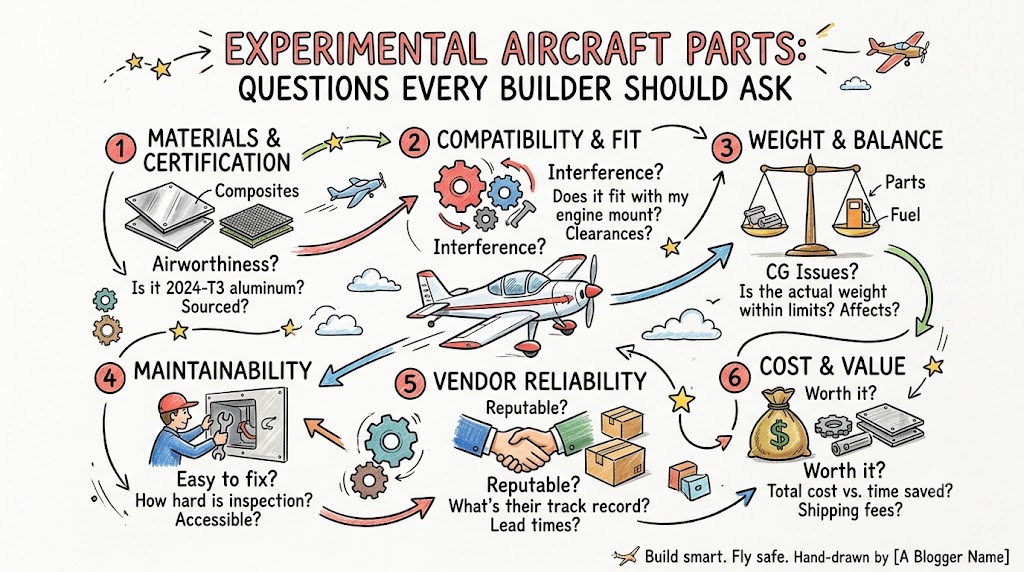
Introduction
Building an experimental aircraft is one of the most rewarding projects an aviation enthusiast can undertake. It combines engineering, craftsmanship, patience, planning, technical research, and a strong commitment to safety. Every component, from a small fastener to a major structural assembly, can influence how the aircraft performs, handles, and operates over time.
Experimental aircraft builders often have more flexibility than owners of standard production aircraft. This freedom makes homebuilt aviation exciting, but it also creates greater responsibility. Builders must carefully evaluate the suitability, quality, condition, history, and installation requirements of every part they use.
A component may look correct and still be unsuitable because of an incorrect alloy, wrong revision level, hidden damage, poor storage, incompatible dimensions, or undocumented modifications. Even a low-cost item can create major problems if it affects the fuel system, flight controls, electrical system, engine, or aircraft structure.
What Are Experimental Aircraft Parts
Experimental aircraft parts are components used in kit-built, amateur-built, custom-designed, restored, or modified aircraft operating within an experimental category.
These parts may be supplied by:
- Kit manufacturers
- Engine manufacturers
- Independent aviation suppliers
- Avionics companies
- Specialty fabricators
- Aircraft salvage businesses
- Previous aircraft owners
- Other builders
- Machine shops
- The builder directly
Experimental aircraft components can include:
- Wing and fuselage structures
- Control surfaces
- Flight control linkages
- Landing gear components
- Wheels and brakes
- Engine mounts
- Engine accessories
- Propeller systems
- Fuel tanks and fuel lines
- Pumps and valves
- Electrical wiring and connectors
- Circuit protection devices
- Avionics
- Antennas
- Fasteners and hardware
- Composite materials
- Fabric covering systems
- Cabin components
- Cooling systems
- Exhaust components
Some parts are designed specifically for a particular kit. Others may be adapted from another aircraft, fabricated by the builder, or purchased as generic aviation components.
Because there is no single universal solution for every aircraft project, builders must verify each component against their specific aircraft design, engine configuration, plans, and operating needs.
Why Part Selection Matters
Part selection directly affects the reliability and safety of an experimental aircraft.
The wrong component may influence:
- Structural strength
- Aircraft weight
- Center of gravity
- Control movement
- Engine reliability
- Fuel flow
- Electrical capacity
- Cooling performance
- Braking
- Landing gear operation
- Avionics reliability
- Maintenance requirements
- Inspection results
- Long-term operating costs
A component that saves money during construction may create expensive repairs later if it is difficult to maintain, unsupported by the manufacturer, or incompatible with other systems.
Builders should evaluate total value rather than purchase price alone.
Is This Part Compatible With My Aircraft Design
Compatibility should always be the first question.
A part may fit one version of a kit but not another. Manufacturers sometimes change designs, dimensions, hardware, and installation methods between production batches or kit revisions.
Confirm compatibility using:
- Aircraft model
- Kit version
- Kit serial number
- Current construction drawings
- Builder manual
- Manufacturer instructions
- Engine model
- Propeller configuration
- Electrical system voltage
- Avionics installation
- Previous aircraft modifications
- Installation dimensions
Do not assume that two aircraft with similar appearances use identical components.
When uncertainty exists, contact the kit manufacturer or an experienced technical professional before purchasing.
Is This the Correct Part Number
A similar part number can refer to a completely different component.
Verify:
- Full part number
- Prefixes and suffixes
- Revision level
- Superseded part numbers
- Left-side or right-side version
- Material specification
- Size
- Thread type
- Finish
- Electrical rating
- Pressure rating
- Temperature limit
A supplier may describe a component as compatible, but the builder should still compare the actual number with the plans and technical documents.
Who Manufactured the Part
Knowing the manufacturer helps determine the origin, design intent, installation requirements, and support available for the part.
Ask whether the component was produced by:
- The kit manufacturer
- An original equipment manufacturer
- An independent aviation supplier
- A local machine shop
- A previous owner
- A repair facility
- A builder
- An unknown source
A component from an unknown source may require additional inspection and verification.
Manufacturer identification can also help the builder obtain manuals, drawings, technical advice, replacement parts, and warranty support.
Is the Supplier Reputable
A reliable supplier should be able to provide clear and accurate information.
Evaluate the supplier based on:
- Product descriptions
- Technical knowledge
- Response quality
- Documentation
- Packaging
- Return terms
- Warranty terms
- Part identification
- Traceability
- Experience with experimental aircraft
- Willingness to answer questions
Online ratings can provide some information, but they should not be the only factor.
A professional supplier should not pressure the buyer to make a quick decision or avoid answering technical questions.
What Material Is the Part Made From
Material selection is critical in aircraft construction.
A part may need to withstand:
- Structural loads
- Heat
- Vibration
- Corrosion
- Pressure
- Electrical current
- Fuel exposure
- Weather
- Repeated cycles
- Fatigue
Common materials include:
- Aluminum alloys
- Carbon steel
- Stainless steel
- Titanium
- Composite materials
- Wood
- Copper
- Rubber
- Plastic
- Fabric
- Electrical insulation
Different grades of the same material can have very different properties.
For example, two pieces of aluminum may look identical but have different strength, hardness, corrosion resistance, or forming characteristics.
Ask for the material specification when the component serves a structural or safety-critical function.
Does the Part Meet the Required Specification
The correct material alone is not enough. The part must also meet the required dimensions, treatment, finish, strength, and operating limits.
Confirm:
- Dimensions
- Tolerances
- Heat treatment
- Surface finish
- Coating
- Strength rating
- Pressure limit
- Temperature limit
- Electrical capacity
- Torque requirement
- Installation clearance
Builders should follow the current project plans and manufacturer guidance.
Do not substitute a different specification simply because the component appears similar.
Is the Part New, Used, Repaired, or Overhauled
Condition descriptions can be confusing.
A component may be described as:
- New
- New old stock
- Used
- Serviceable
- Repaired
- Rebuilt
- Overhauled
- Surplus
These terms do not always provide enough information.
Ask for a precise description of the component’s actual condition.
New old stock may never have been installed, but age and poor storage can still affect seals, rubber, adhesives, coatings, batteries, or electronic components.
Used components may provide good value, but they require careful review of history, condition, remaining life, and documentation.
What Is the Part’s History
Part history is particularly important for used, repaired, or overhauled components.
Ask about:
- Previous aircraft installation
- Total operating time
- Number of cycles
- Reason for removal
- Storage conditions
- Accident involvement
- Hard landing exposure
- Heat exposure
- Corrosion
- Repairs
- Modifications
- Inspection history
- Overhaul history
Missing history creates uncertainty.
This does not automatically make the part unusable, but it may justify a more detailed inspection or professional evaluation.
Is Documentation Available
Useful documentation may include:
- Purchase invoice
- Manufacturer label
- Serial number
- Batch number
- Material certificate
- Inspection report
- Repair record
- Overhaul record
- Test report
- Installation instructions
- Wiring diagram
- Maintenance record
- Service history
Documentation supports future maintenance, troubleshooting, inspection, and resale.
It also helps the builder prove where the component came from and how it was evaluated.
Is the Part Traceable
Traceability means that the component’s origin and history can be identified.
Traceability may be supported through:
- Manufacturer information
- Serial numbers
- Batch numbers
- Purchase records
- Inspection records
- Repair documents
- Previous installation records
Not every small part requires the same level of documentation, but traceability becomes increasingly important as the component’s role becomes more critical.
Structural parts, engine components, propeller parts, fuel system components, and flight control items deserve particular attention.
Has the Part Been Inspected
A clean appearance does not prove that a part is serviceable.
Ask whether the component has received:
- Visual inspection
- Dimensional inspection
- Corrosion inspection
- Crack inspection
- Electrical testing
- Pressure testing
- Functional testing
- Non-destructive testing
- Software testing
The appropriate inspection depends on the part.
A flight control bracket may require dimensional and crack inspection, while an electrical component may require load and functional testing.
Are There Signs of Damage or Corrosion
Inspect the component carefully before installation.
Warning signs include:
- Cracks
- Pitting
- Distortion
- Bent edges
- Heat discoloration
- Damaged threads
- Worn bearings
- Loose connectors
- Surface contamination
- Flaking coatings
- Delamination
- Swelling
- Unusual wear
- Missing protective finish
Minor-looking damage can become serious when the part is repeatedly exposed to vibration and flight loads.
When the condition is uncertain, seek professional inspection.
Has the Part Been Modified
Undocumented modifications can affect fit, performance, strength, and reliability.
Ask whether the part has been:
- Drilled
- Cut
- Welded
- Ground
- Repaired
- Refinished
- Rewired
- Reprogrammed
- Heat treated
- Adapted
- Installed on another aircraft type
A modification may be acceptable when it is properly designed and documented.
The risk appears when the change cannot be explained or evaluated.
Does the Part Have a Service Life
Some aircraft parts have limits based on:
- Calendar time
- Operating hours
- Cycles
- Inspections
- Condition
- Shelf life
- Overhaul recommendations
Components that may have replacement or inspection limits include:
- Hoses
- Seals
- Batteries
- Bearings
- Filters
- Belts
- Engine accessories
- Safety equipment
- Rubber components
Builders should avoid assuming that a part has unlimited life simply because it appears usable.
Has the Part Been Stored Correctly
Storage conditions can damage a component before it is ever installed.
Poor storage may expose parts to:
- Moisture
- Heat
- Direct sunlight
- Dust
- Chemicals
- Salt
- Rodents
- Impact damage
- Corrosion
- Freezing temperatures
Rubber products, adhesives, seals, batteries, electrical parts, fabric systems, and precision engine components are particularly sensitive.
Ask how and where the part was stored.
Are Installation Instructions Available
A part should not be installed without adequate technical information.
Useful instructions may include:
- Drawings
- Diagrams
- Torque values
- Fastener requirements
- Wiring instructions
- Sealant guidance
- Alignment requirements
- Clearance requirements
- Inspection steps
- Functional tests
- Safety procedures
When no instructions are available, the builder should determine whether the component is appropriate for the project before proceeding.
Do I Need Special Tools or Skills
Some installations require more than standard hand tools.
The task may require:
- Calibrated torque tools
- Riveting equipment
- Precision measuring tools
- Crimping tools
- Electrical test equipment
- Composite tools
- Welding equipment
- Alignment fixtures
- Machining capability
- Inspection equipment
Improvising without proper tools can damage the part or produce an unreliable installation.
Seek qualified assistance when the work exceeds your training or equipment.
Will the Part Change Aircraft Weight or Balance
Every installed component contributes to aircraft weight and center of gravity.
A modification may affect:
- Empty weight
- Useful load
- Baggage capacity
- Fuel capacity
- Handling
- Stability
- Takeoff performance
- Landing performance
Replacing a small item with a heavier component may seem insignificant, but multiple changes can accumulate.
Document component weights and update weight-and-balance information when required.
Will the Part Affect Other Aircraft Systems
Aircraft systems are interconnected.
A new component may affect:
- Electrical demand
- Cooling
- Structural support
- Fuel flow
- Engine performance
- Avionics
- Flight controls
- Cabin layout
- Landing gear
- Weight and balance
For example, installing higher-power avionics may increase electrical load and heat. A new engine accessory may require different wiring, cooling, or mounting. A fuel system change may affect pressure, filtration, and flow.
Evaluate the complete system rather than the part alone.
Is the Part Suitable for the Operating Environment
The aircraft’s operating environment can influence component selection.
Consider:
- High temperatures
- Cold weather
- Coastal corrosion
- Humidity
- Dust
- Rain
- Vibration
- Altitude
- Fuel type
- Engine heat
- Electrical load
A component that performs well in a dry inland climate may require additional protection in a coastal environment.
Is the Part Suitable for My Engine or Propeller
Engine and propeller compatibility requires careful verification.
Confirm:
- Engine model
- Engine mount
- Fuel system
- Ignition system
- Electrical system
- Cooling system
- Exhaust system
- Propeller type
- Spinner
- Governor
- Weight
- Operating limits
Do not rely on appearance alone.
A component designed for a similar engine may still have different mounting, pressure, electrical, or performance requirements.
Does the Part Require Ongoing Maintenance
A new component becomes part of the aircraft’s maintenance program.
Ask whether it requires:
- Lubrication
- Cleaning
- Retorquing
- Inspection
- Calibration
- Filter replacement
- Seal replacement
- Software updates
- Corrosion prevention
- Functional testing
Add these requirements to the aircraft maintenance records.
Will Replacement Parts Be Available
Future support matters.
Consider:
- Manufacturer stability
- Supplier support
- Replacement hardware
- Consumables
- Software updates
- Repair capability
- Lead times
- Alternative parts
- Obsolescence
A component may perform well but become difficult to maintain if the manufacturer stops supporting it.
What Warranty or Return Policy Applies
Review warranty and return terms before installation.
Ask about:
- Warranty duration
- Covered defects
- Installation conditions
- Return eligibility
- Restocking fees
- Shipping responsibility
- Damage claims
- Electrical part restrictions
- Used part exclusions
- Documentation requirements
Many suppliers will not accept a component after it has been drilled, wired, programmed, or installed.
Should a Qualified Person Review the Part
Seeking help is a responsible part of aircraft building.
A builder may benefit from consulting:
- An experienced homebuilder
- An aviation mechanic
- An engineer
- A technical counselor
- The kit manufacturer
- The engine manufacturer
- An avionics specialist
- A composite specialist
Professional review is especially valuable for structural parts, flight controls, fuel systems, engine installations, and major modifications.
Questions to Ask Before Buying Structural Components
Structural parts deserve careful evaluation because they carry flight and landing loads.
Ask:
- What material is used?
- Has the material been heat treated?
- Are the dimensions correct?
- Has the part been drilled before?
- Are there cracks or corrosion?
- Has the part been repaired?
- Is the surface finish intact?
- Are the fasteners compatible?
- Was the part stored properly?
- Is inspection documentation available?
- Is the part intended for a load-carrying location?
- Does the installation match the current plans?
Never remove material, enlarge holes, or perform a structural repair without appropriate technical guidance.
Questions to Ask Before Buying Engine Parts
Engine components require detailed review because failures can have serious consequences.
Ask:
- Is the part compatible with the exact engine model?
- What is the complete part number?
- What is the service history?
- How many operating hours are recorded?
- Has the part been repaired or overhauled?
- How was it stored?
- Is corrosion present?
- Has it been inspected?
- Are service limits known?
- Are installation instructions available?
- Is a warranty provided?
- Will future replacements be available?
Safety-critical engine work should be evaluated by qualified people.
Questions to Ask Before Buying Electrical and Avionics Components
Before purchasing an electrical or avionics component, verify:
- System voltage
- Current requirement
- Circuit protection
- Connector type
- Wiring diagram
- Software compatibility
- Installation dimensions
- Cooling requirement
- Antenna requirement
- Environmental limits
- Electrical load
- Firmware support
- Database support
- Warranty
A component that works on the bench may still be unsuitable for the aircraft’s electrical environment.
Questions to Ask Before Buying Fuel System Parts
Fuel system parts must be selected carefully to prevent leaks, restrictions, and compatibility problems.
Ask:
- Is the component compatible with the intended fuel?
- What is the pressure rating?
- What is the temperature rating?
- Is the hose material suitable?
- Are the seals compatible?
- What fitting type is required?
- Are the threads correct?
- Does installation direction matter?
- Is filtration required?
- Is there an inspection requirement?
- Is there a replacement interval?
- Is heat protection required?
Fuel system installations should be checked thoroughly before operation.
Questions to Ask Before Buying Used Aircraft Parts
Used components may offer good value, but they require additional review.
Check:
- Identity
- Source
- Part number
- Serial number
- Previous use
- Operating time
- Accident history
- Storage
- Corrosion
- Repairs
- Modifications
- Remaining service life
- Inspection
- Documentation
- Return terms
Never accept vague descriptions as a substitute for actual condition information.
New Parts vs Used Parts
| Comparison Factor | New Parts | Used Parts | What the Builder Should Verify |
|---|---|---|---|
| Condition | Usually unused | Depends on history | Actual physical condition |
| Documentation | Often more complete | May be limited | Available records |
| Cost | Usually higher | May be lower | Total value and risk |
| Warranty | May be available | Often limited | Written terms |
| Service life | Usually unused | May be partially consumed | Remaining life |
| Availability | May involve lead time | May be available quickly | Exact compatibility |
| Inspection | Still required | More detailed inspection may be needed | Suitable inspection method |
| Traceability | Often easier | May be incomplete | Source and history |
Red Flags Builders Should Never Ignore
Be cautious when you notice:
- Missing part numbers
- Removed identification labels
- Unknown manufacturing source
- Unexplained modifications
- Visible corrosion
- Cracks
- Damaged threads
- Poor welding
- Missing documentation
- Suspiciously low pricing
- Seller pressure
- Inconsistent descriptions
- Refusal to provide photographs
- No return policy
- Claims that inspection is unnecessary
These signs do not always prove that the part is unusable, but they justify further investigation.
Common Experimental Aircraft Parts Buying Mistakes
Builders should avoid:
- Buying based only on price
- Assuming similar parts are interchangeable
- Ignoring revision levels
- Using unsuitable general hardware
- Buying used parts without history
- Failing to inspect components
- Ignoring storage damage
- Installing without instructions
- Making undocumented modifications
- Forgetting weight-and-balance effects
- Failing to update build records
- Ignoring future support
Experimental Aircraft Parts Evaluation Checklist
Before purchasing or installing a component, confirm:
- Part description
- Part number
- Revision level
- Aircraft compatibility
- Manufacturer identity
- Supplier reputation
- Condition
- Material
- Dimensions
- Documentation
- Traceability
- Service history
- Corrosion status
- Damage status
- Modification history
- Installation instructions
- Required tools
- Maintenance requirements
- Weight impact
- Warranty
- Return policy
- Need for professional review
- Purchase record
- Installation record
How to Maintain Accurate Build Records
Good records are essential throughout construction and operation.
Record:
- Purchase date
- Supplier
- Part number
- Serial number
- Batch number
- Material specification
- Installation date
- Installation location
- Modification details
- Inspection results
- Photographs
- Receipts
- Maintenance requirements
- Replacement dates
- Technical references
Accurate records simplify future inspections, troubleshooting, upgrades, maintenance, and resale.
Frequently Asked Questions
1. What are experimental aircraft parts?
Experimental aircraft parts are components used in kit-built, amateur-built, custom-designed, or modified aircraft operating within an experimental category. They may be supplied by kit manufacturers, independent aviation companies, specialty fabricators, previous owners, or the builder. These parts can include structural components, engine accessories, avionics, fuel system items, electrical equipment, controls, landing gear, and hardware.
2. Can certified aircraft parts be used on an experimental aircraft?
Certified aircraft parts may sometimes be used when they are compatible with the aircraft design and installation. However, suitability should not be assumed based only on certification status. The builder should verify dimensions, operating limits, system compatibility, weight, installation requirements, and project documentation. Technical guidance may be helpful for critical installations.
3. Are used parts safe for kit-built aircraft?
Used parts can be suitable when their identity, condition, history, remaining life, and compatibility are properly evaluated. Builders should inspect used components carefully and review any available records. Parts with unknown history, visible damage, corrosion, undocumented repairs, or missing identification may require professional inspection before use.
4. How can a builder confirm part compatibility?
Compatibility can be checked using current plans, kit manuals, manufacturer documentation, part numbers, dimensions, engine configuration, electrical requirements, and installation drawings. Builders should also review previous modifications. When uncertainty remains, contact the kit manufacturer, supplier, or a qualified aviation professional.
5. Why is aircraft parts traceability important?
Traceability helps identify where a component came from, who manufactured it, how it was used, and whether it was repaired or inspected. This information supports maintenance, troubleshooting, safety evaluation, and future replacement. Traceability becomes especially important for structural, engine, propeller, fuel, and flight control components.
6. What should I inspect before buying a used component?
Check the part number, serial number, material, dimensions, corrosion, cracks, wear, damaged threads, previous repairs, modifications, and storage condition. Ask for service history, operating time, accident involvement, inspection records, and the reason for removal. A professional inspection may be appropriate for critical components.
7. Can automotive parts be used in an experimental aircraft?
Some builders may consider components from other industries, but suitability must be evaluated carefully. Automotive parts may not be designed for aircraft vibration, temperature, altitude, fuel type, weight limits, or failure consequences. Builders should compare specifications and obtain appropriate technical guidance before using any non-aviation component.
8. How should aircraft parts be stored?
Parts should be stored in a clean, dry, protected environment away from moisture, direct sunlight, dust, chemicals, and impact. Sensitive items such as seals, hoses, batteries, adhesives, electronics, fabrics, and precision components may require special temperature or packaging controls. Manufacturer storage instructions should be followed when available.
9. When should a builder consult a qualified professional?
Professional guidance is especially important for structural repairs, flight control systems, fuel systems, engine installations, propeller components, welding, electrical design, and major modifications. Builders should also seek help whenever the required inspection, tooling, or technical knowledge exceeds their experience.
10. What records should be kept for every installed part?
Keep the purchase invoice, supplier information, part number, serial number, batch number, material data, inspection results, installation date, photographs, manuals, warranty information, and maintenance requirements. Also record any modifications, repairs, replacements, or tests. These records improve long-term aircraft support and future troubleshooting.
Conclusion
Every experimental aircraft component should be evaluated carefully before purchase or installation. Compatibility, material, condition, history, documentation, traceability, installation requirements, and future support all influence whether a part is suitable for a specific project.
Asking detailed questions helps builders reduce uncertainty, avoid unsuitable components, improve workmanship, and maintain more complete construction records. It also encourages responsible decision-making when working with structural parts, engine systems, fuel components, avionics, electrical equipment, and used aircraft parts.

